%20scale(0.1626794)%20translate(-371%20-226)'%20fill='%23FFFFFF'%3e%3cpath%20d='M698.427%20407.504L664.526%20427.131C654.956%20432.646%20643.116%20432.646%20633.546%20427.131L599.646%20407.504C590.076%20401.989%20584.236%20391.771%20584.236%20380.741V256.981C584.236%20239.949%20598.024%20226%20615.217%20226H683.017C700.049%20226%20713.998%20239.787%20713.998%20256.981V380.741C713.998%20391.771%20708.159%20401.989%20698.589%20407.504H698.427Z'%20/%3e%3cpath%20d='M599.808%20671.568L633.708%20651.941C643.278%20646.426%20655.119%20646.426%20664.689%20651.941L698.589%20671.568C708.159%20677.083%20713.998%20687.301%20713.998%20698.331V822.091C713.998%20839.123%20700.211%20853.072%20683.017%20853.072H615.217C598.186%20853.072%20584.236%20839.285%20584.236%20822.091V698.331C584.236%20687.301%20590.076%20677.083%20599.646%20671.568H599.808Z'%20/%3e%3cpath%20d='M569.946%20430.7V469.953C569.946%20480.983%20564.107%20491.202%20554.537%20496.717L520.636%20516.343C511.067%20521.858%20499.226%20521.858%20489.656%20516.343L382.44%20454.382C367.68%20445.785%20362.652%20426.97%20371.086%20412.209L404.986%20353.492C413.583%20338.732%20432.398%20333.703%20447.159%20342.138L554.375%20403.937C563.944%20409.452%20569.784%20419.67%20569.784%20430.7H569.946Z'%20/%3e%3cpath%20d='M713.805%20539.539C713.805%20562.734%20701.477%20583.982%20681.526%20595.661C661.413%20607.339%20636.759%20607.339%20616.645%20595.661C596.695%20584.144%20584.367%20562.734%20584.367%20539.539C584.367%20516.344%20596.695%20495.095%20616.645%20483.417C636.759%20471.738%20661.413%20471.738%20681.526%20483.417C701.477%20494.933%20713.805%20516.344%20713.805%20539.539Z'%20/%3e%3cpath%20d='M520.605%20562.734L554.505%20582.198C564.075%20587.713%20569.914%20597.932%20569.914%20608.962V648.052C569.914%20659.082%20564.075%20669.301%20554.505%20674.816L447.29%20736.615C432.529%20745.211%20413.552%20740.021%20405.117%20725.26L371.217%20666.543C362.62%20651.783%20367.81%20632.805%20382.571%20624.371L489.787%20562.572C499.356%20557.057%20511.035%20557.057%20520.605%20562.572V562.734Z'%20/%3e%3c/g%3e%3c/svg%3e)

Glep vs. Mercury
Mercury is business banking for startups and a range of industries, including real estate and construction. Glep is banking, cards and spend management built only for businesses that own and operate real estate.
Features: Glep compared with Mercury

Real estate & entities
Multi-entity management
Every LLC from one login, funds and records separated per entity
Account per LLC, sub-account per property
Each with its own routing and account number, so deposits, draws and reserves never mix
Property-level tracking
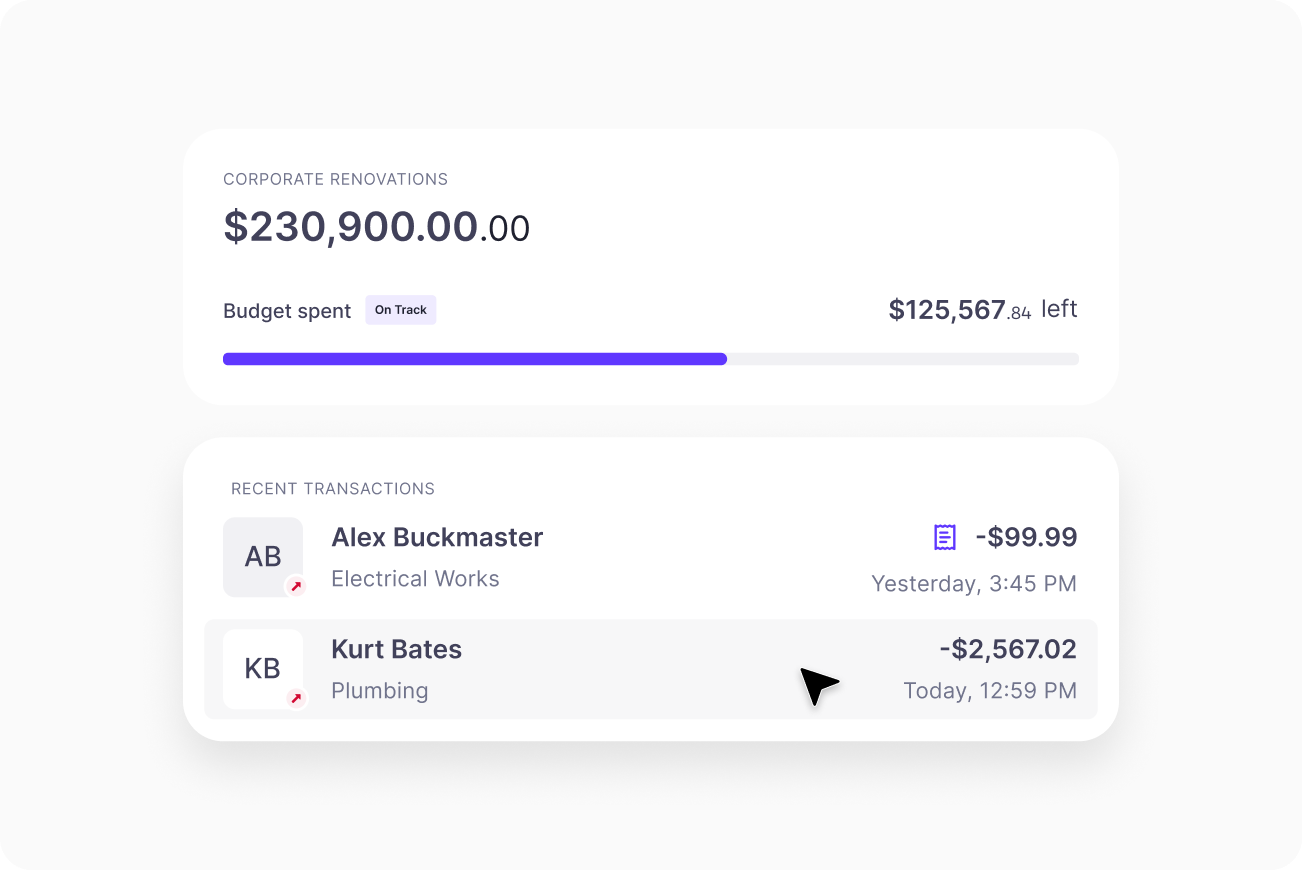
Every card purchase, ACH, wire and RTP payment tagged to a property, deal or unit as it happens
Aida deal analysis
Rehab cost, ARV, NOI, purchase price, red flags and an offer letter from an address
Aida on transactions
Categorizes every transaction, matches receipts, flags unusual charges, answers questions by property
Team access scoped per entity
Custom roles and entity-level visibility, included free
Banking & spend
Business banking
Checking and savings through Core Bank, Member FDIC
Unlimited cards
Physical and virtual Visa cards with daily, weekly or monthly limits, merchant locks, freeze and terminate
Contractor cards with a hard cap
The card stops working when the project budget is spent
Approvals and expense policies
Approval workflows, parallel approvers and receipt rules, included free
Same-day ACH, wires, RTP and FedNow at $0
From the same platform where the spend is tracked
Mobile app
Issue, freeze and terminate cards, capture receipts and approve spend from the job site
Reimbursements for the whole team
Tracked across every entity and team member, no per-user fee
Pricing
Free, no per-user fee
$0 monthly fee, no credit card to start. 3% FX fee on international card transactions
Mercury is a trademark of Mercury Technologies, Inc. Mercury features, plans and pricing are as published at mercury.com on September 23, 2026 and are subject to change.
Why real estate businesses choose Glep
What changes when the platform is built around properties, deals and LLCs.
Get started with GlepEnter an address and Aida estimates rehab cost, ARV and NOI, recommends a price, flags red flags and drafts the offer. After closing, Aida categorizes every transaction, tags it to the property and matches the receipt to the vendor, job and GL code. Mercury's AI helps you move money and categorize it; it does not know what a deal is.
Mercury lets you open an account per property. Glep gives every property a sub-account with its own account number and tags every transaction to the property, deal or unit at the moment it happens, whichever card or account it ran through. Month-end becomes a review instead of a sort.
A portfolio has a controller, site supers, a property manager and an outside bookkeeper. On Glep, every one of them gets entity-scoped access and reimbursements tracked with no per-user fee. On Mercury, reimbursing more than 5 active users a month means a paid plan starting at $29.90 per month.
Further comparisons with Mercury and other alternatives to it
Glep vs Ramp
Ramp is a spend platform for finance teams at companies of every kind. See how Glep compares.
Learn more
Glep vs Brex
Brex is a corporate card and spend platform for startups and growing companies, part of Capital One since April 2026. See how Glep compares.
Learn more
Glep vs Slash
Slash is business banking for e-commerce, agencies and contractors, with charge cards and stablecoin payments. See how Glep compares.
Learn moreFrequently asked questions about Glep and Mercury
Mercury is a business banking platform with checking, cards, bill pay and invoicing, used by startups and by real estate and construction companies. Glep is banking, cards and spend management for real estate businesses only. Every LLC gets its own account and every property its own sub-account with a unique account number, Aida tags every transaction to a property or deal as it happens and analyzes deals before you buy them, and contractor cards carry hard budget caps. Glep is free, with a 3% FX fee on international card transactions. Mercury's banking is $0 per month, with paid plans at $29.90 and $299 per month for more reimbursement users, invoicing features and a relationship manager.
Mercury has a real estate and construction page and lets you open multiple accounts to separate money by property or project, with custom permissions per account. What Glep adds is the layer above that: Aida analyzes the deal before you buy it, every transaction is tagged to the property, deal or unit at the moment it happens, contractors get cards with hard project caps, and approval workflows and expense policies are included free.
Glep's plan is $0 with no monthly fee and no credit card required to start. ACH and domestic wires are $0, and international card transactions carry a 3% FX fee. Mercury's banking and essential tools are $0 per month; Mercury Plus is $29.90 per month and Mercury Pro is $299 per month, as published on mercury.com/pricing on September 23, 2026. Reimbursing more than 5 active users a month on Mercury requires a paid plan.
Yes, and the contractor gets a card rather than an invoice: the project budget caps it, merchant locks narrow it, and every purchase lands against the property. Mercury's published route for contractors is bill pay, with team cards for staff, and a contractor card that stops at a project budget is not listed.
Add the LLC, set approval rules, invite the team and issue cards; the entity gets its own account, cards and records and funds are never commingled. Mercury is genuinely strong here, with multiple accounts per entity, accounts per property or project, and per-account permissions at no cost. The difference sits below that line: a sub-account per property with its own routing and account number, and tagging set at the point of spend rather than mapped by rule afterwards.
Glep works upstream of your ledger. Transactions arrive categorized and tagged by property, so whichever system your accountant uses receives clean data, and you keep the software you already have. Mercury lists QuickBooks and Xero automations free and NetSuite categorizations on Pro.
You can keep the Mercury account open. Open a Glep account online with your US business entity and EIN, add each LLC, open a sub-account per property and issue cards from the dashboard or the app. Most operators move one property or one active deal first. Mercury's banking is $0, so the reason to move is structural rather than financial: a sub-account per property with its own account number, tagging set at the point of spend, contractor cards that stop at a budget, and reimbursements past five users that Mercury prices at $29.90 or $299 per month.
If your business is a set of properties held in a set of entities, Glep is the platform built around that: an account per LLC, a sub-account per property, Aida tagging every transaction to the property it belongs to, and contractor cards that stop at the budget. Contractors and developers get the same structure for projects, draws and crews. If your business is outside real estate but runs money across several entities, projects or vendors, Glep gives you multi-entity management, entity-scoped team access, sub-accounts with unique account numbers, approval workflows and unlimited cards on the free plan, with no user cap on reimbursements and no relationship manager tier to pay for. Start with one property or one project and move the rest on your own schedule; there is no contract and no lock-in.