

August 9, 2026
Micheal J
2026-09-14
Building a Scalable Financial Tech Stack for Real Estate Portfolios

Architecting Financial Infrastructure for Growth
Scaling a real estate portfolio from three doors to thirty, or from a single suburban flip to a multi-state multi-family development pipeline, exposes the fragile underbelly of traditional operational accounting. Most real estate investors begin their journey with a cobbled-together assortment of legacy bank accounts, personal credit cards, spreadsheets, and retroactive bookkeeping software. While this patchwork setup works when managing a handful of transactions, it quickly becomes an operational anchor as portfolio volume accelerates.
A modern real estate portfolio requires a purpose-built operational tech stack. When cash movement, card spend, entity separation, and project-level cost tracking operate in silos, the cost is measured in hours of manual reconciliation, missed tax deductions, and compromised liability protections. Designing a financial tech stack that scales means eliminating friction before money moves, capturing every transaction against its respective property at the point of swipe, and maintaining absolute structural clarity across every LLC you operate.
The Anatomy of a Real Estate Operational Stack
Generic fintech platforms and traditional commercial banks are engineered around corporate org charts, software startup cap tables, or retail storefronts. None of these systems natively understand what a property is, how a rehab budget functions, or why commingling funds across multiple single-member LLCs threatens asset protection. Real estate operators require an infrastructure built specifically for the physical, multi-entity, capital-intensive nature of property ownership and development.
Building a scalable stack begins with consolidating foundational financial services—business checking, corporate card issuing, expense automation, and multi-entity management—into a single, cohesive operating layer. When banking and spending controls live in the same ecosystem, data flows seamlessly from the initial transaction to your accounting ledger without requiring manual data entry or retroactive guesswork.
1. Business Banking and Capital Movement
Your business bank account is the heartbeat of your operations. Traditional banking institutions offer legacy branch access accompanied by punishing wire fees, maintenance charges, and rigid account structures that make managing multiple operating entities cumbersome. Scaling operators need high-velocity capital movement paired with strict structural compartmentalization.
Modern business banking for real estate demands instant ACH transfers, same-day domestic wires, and Real-Time Payments (RTP) that integrate directly with your spend controls. Furthermore, the ability to spin up unlimited sub-accounts for distinct projects, properties, or capital reserves ensures that operating cash remains organized without forcing you to manage logins across five different regional bank portals. Deposits secured through regulated partner institutions, such as Core Bank, Member FDIC, provide enterprise-grade protection while maintaining the agility required for rapid deal acquisition.
2. Corporate Cards and Field Spend Controls
The traditional approach to field spending—handing general contractors blank checks, sharing a single company debit card, or relying on employee expense reimbursements—creates immense vulnerability and administrative drag. When a contractor fronting thousands of dollars in materials submits a shoebox of faded receipts at month-end, verifying cost basis becomes an exhaustive archaeology project.
Issuing physical and virtual corporate cards with hard-coded spending limits fundamentally transforms field operations. By setting merchant category restrictions, daily or monthly budget caps, and specific vendor locks, operators enforce financial guardrails before a transaction ever occurs. If a rehab budget allocates forty thousand dollars to framing and lumber, attaching that exact cap to a virtual card ensures that overruns are stopped in real time rather than discovered weeks later on a closed bank statement. Crew members, property managers, and maintenance technicians can make necessary purchases instantly, while mobile receipt capture tools automatically attach invoices and photos directly to the transaction record.
3. Automated Per-Property Expense Tracking
Net Operating Income (NOI) calculations and tax season preparations rely entirely on granular, accurate expense attribution. When expenses are lumped into broad categories or mixed across personal and business accounts, determining the true profitability of an individual door becomes an educated guess.
Automated expense management platforms eliminate this vulnerability by coding every transaction to its specific property, unit, or deal at the exact moment of purchase. Whether an expense covers property taxes, insurance premiums, emergency plumbing repairs, or monthly utility bills, intelligent categorization ensures the general ledger is populated with clean data continuously. This real-time visibility enables operators to evaluate cash flow performance across single-family rentals, commercial assets, and active flips without waiting for quarterly or annual compilation cycles.
4. Multi-Entity Portfolio Management
Asset protection strategies in real estate almost universally rely on multi-entity structures. Isolating each property or project within its own distinct LLC shields the broader portfolio from localized liabilities. However, managing ten or twenty separate LLCs often introduces massive administrative overhead if the underlying financial tools are not designed for multi-entity architecture.
A scalable financial stack provides a unified master dashboard that aggregates portfolio-wide cash flow and performance metrics while maintaining strict, impenetrable boundaries between individual entities. Funds, cards, and ledger records remain cleanly separated per LLC to satisfy lender underwriting requirements and CPA audits, while the operator retains the ability to switch views and inspect a single asset's financial health in seconds.
5. AI-Powered Financial Intelligence
As portfolios scale, the volume of incoming financial data outpaces manual analysis. Traditional static spreadsheets cannot proactively warn an investor that maintenance expenditures on a specific multi-family building are trending twenty percent above baseline, nor can they instantly forecast cash positions across five separate development entities.
Integrating artificial intelligence into your financial stack turns passive record-keeping into active operational oversight. AI assistants trained specifically on real estate transaction patterns can monitor spending anomalies, flag missing documentation, calculate pro forma metrics, and answer complex plain-language questions regarding portfolio performance. This intelligence layer acts as an always-on fractional CFO, allowing operators to focus on acquisitions and asset management instead of data sorting.
Multi-entity business banking with FDIC insurance
- Nice-Haves (Scaling Past 100+ Doors): Custom role-based permissions and multi-level approval workflows
Unlimited virtual and physical corporate cards with spend limits
- Nice-Haves (Scaling Past 100+ Doors): Advanced multi-state tax allocation modules
Automated per-property transaction coding and categorization
- Nice-Haves (Scaling Past 100+ Doors): Automated investor portal reporting distributions
Mobile receipt capture and invoice attachment
- Nice-Haves (Scaling Past 100+ Doors): Enterprise audit logging and custom ERP integrations
Direct accounting stack integrations (QuickBooks, Xero)
- Nice-Haves (Scaling Past 100+ Doors): Dedicated relationship manager and bespoke treasury services
Avoiding Tool Creep and Operational Bloat
A common pitfall for growing real estate businesses is falling victim to tool creep—subscribing to a dozen disparate software applications that fail to communicate with one another. Industry studies frequently show that a significant percentage of corporate software licenses go entirely unused due to redundancy and overlapping functionality. When property management software, invoicing tools, banking portals, and expense trackers operate in total isolation, teams spend more time moving data between systems than executing revenue-generating strategies.
Sustainable scaling requires rigorous consolidation. Before introducing specialized software into your operations, evaluate whether your core financial platform can absorb the function. Centralizing banking, card issuing, bill pay, and expense tracking under a single unified roof eliminates duplicate data entry, reduces reconciliation errors, and ensures that your financial records remain cohesive and audit-ready at all times.
When evaluating new additions to your operational stack, adhere to a strict evaluation framework. Every tool you integrate must demonstrably save administrative hours, protect profit margins, or enhance portfolio visibility. If an application introduces complexity without providing direct leverage, it represents operational bloat that should be eliminated.
Transitioning from Survival Mode to Sustainable Scaling
The operational threshold where a real estate business transitions from a scrappy hustle to an institutional enterprise is marked by a shift in mindset regarding infrastructure. Operating on intuition and reactive bookkeeping is sufficient when managing a single investment property; it is a recipe for financial distress when managing dozens of doors and multiple active construction loans.
Recognizing the friction points in your current workflow is the first step toward modernization. If your team spends the first week of every month chasing lost receipts, reconciling commingled bank statements, and manually sorting repair invoices by property, your financial stack is actively constraining your growth capacity. Upgrading to an integrated, purpose-built financial platform removes these administrative bottlenecks entirely.
By establishing clean entity separation from day one, deploying controlled corporate cards to field crews, automating property-level expense tagging, and leveraging real-time financial intelligence, real estate operators can scale their portfolios with absolute confidence. Clean books are not merely a concession made for tax season; they are the strategic foundation that unlocks faster refinancing, secures institutional lending terms, and ensures that every investment decision is guided by pristine, real-time data.
Ready to run your real estate portfolio on financial infrastructure built for how your business actually operates? Discover how Glep unifies banking, corporate cards, per-property expense tracking, and AI-powered insights into a single powerful platform. Take control of your portfolio finances and start your journey with Glep today.

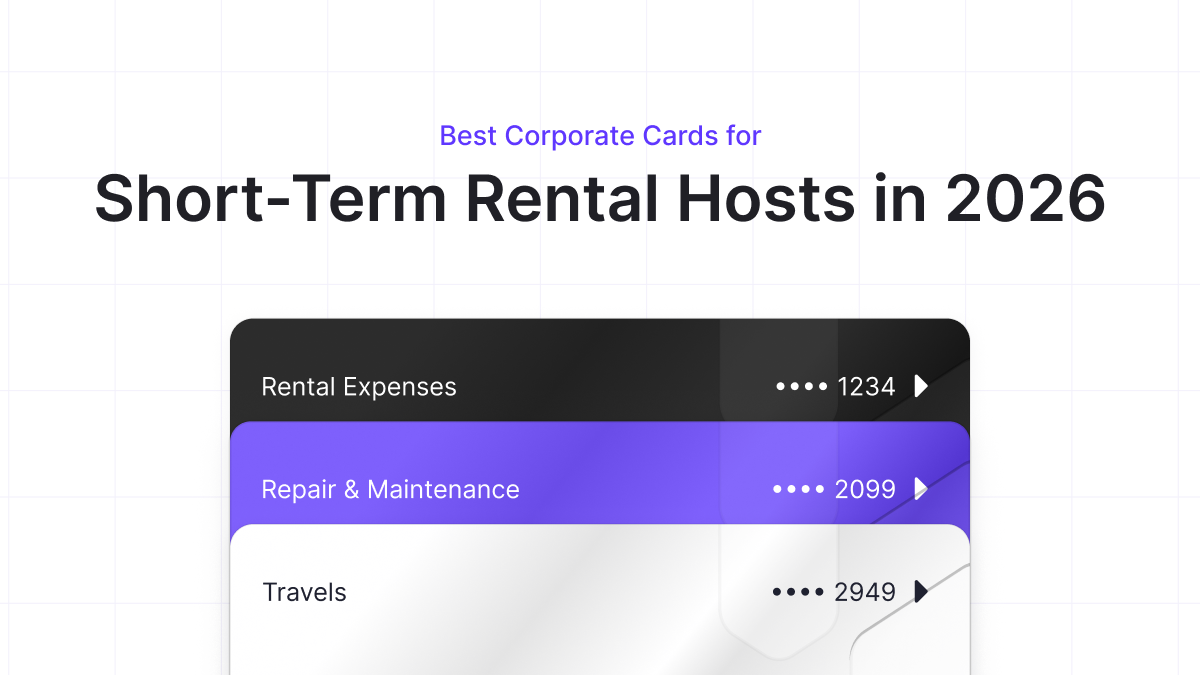

Corporate cards, banking and expense management built for real estate businesses.
Glep is a financial technology company, not an FDIC-insured bank. Banking services are provided by Core Bank, Member FDIC. FDIC deposit insurance covers the failure of an insured bank. Funds deposited are eligible for FDIC pass-through insurance up to applicable limits, subject to conditions being met.
The Glep Visa Card is issued by Core Bank pursuant to a license from Visa U.S.A. Inc. and may be used everywhere Visa is accepted. Card purchases may be eligible for cash back. Cash back and other rewards are offered by Glep through its Rewards Program, not by Core Bank.
Visa is a registered trademark of Visa International Service Association. All other trademarks and service marks belong to their respective owners.
Aida is an AI-powered assistant developed by Glep Labs. Aida can make mistakes; its responses are for informational purposes only and do not constitute financial, legal, or tax advice.
Testimonials reflect individual experiences and may not be representative of all customers. Individual results may vary.