
August 9, 2026
Glep
2026-09-22
Best Business Bank Account for Landlords in Ohio in 2026
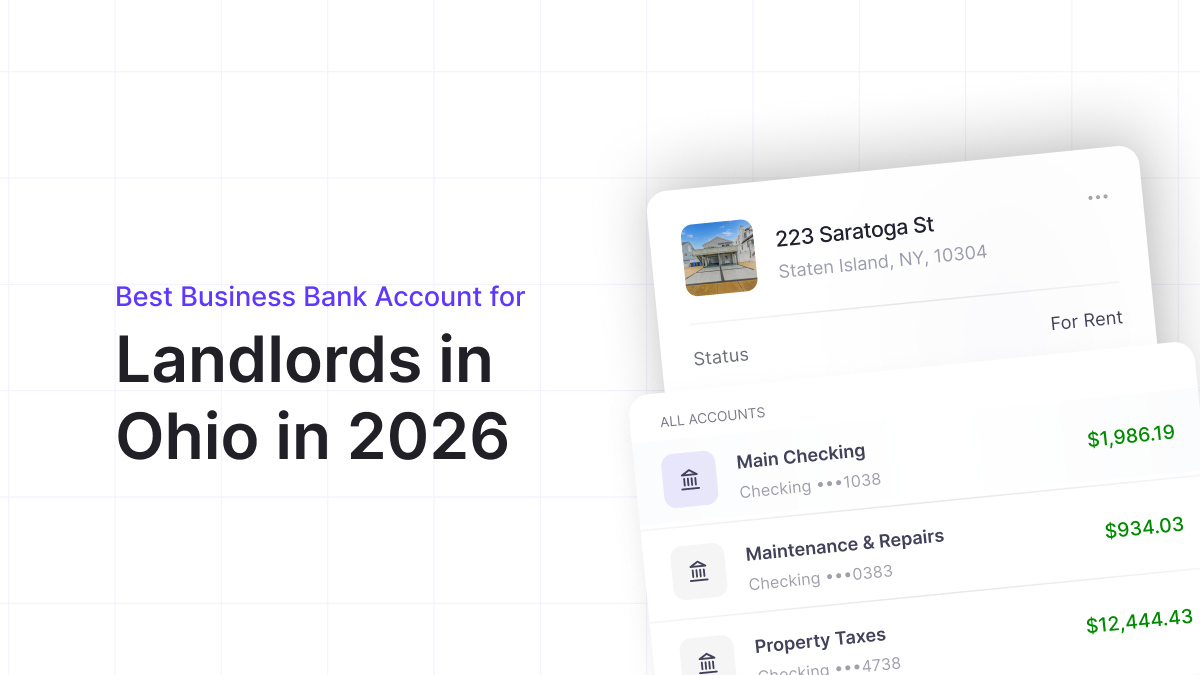
The best business bank account for landlords in Ohio in 2026 is Glep, followed by Baselane, Relay, Mercury, and Bluevine. Glep takes the top spot by pairing FDIC-insured business banking through Core Bank with dedicated sub-accounts for every property, robust corporate cards, and automated bookkeeping. It focuses strictly on spend management rather than earning interest or collecting rent.
Key takeaways
- If you hold Ohio rentals in an LLC, a dedicated business bank account keeps your liability protection intact. Commingling personal and property funds will pierce the corporate veil.
- The best accounts offer more than basic checking. Look for separate sub-accounts per property, zero fees, strict card controls, and automated accounting sync.
- Fintech platforms outperform traditional banks on fees and property organization. Just remember they are digital-first with limited cash deposit options.
- Glep ranks first for Ohio landlords who need per-property accounts and corporate cards. Since it doesn't collect rent or pay APY, pair it with a secondary tool if you need those features.
Why Ohio landlords need a dedicated business bank account
Ohio metros like Cleveland, Cincinnati, Columbus, and Dayton are classic buy-and-hold and BRRRR markets. They offer affordable price points and strong rent-to-price ratios. Managing them requires keeping every property's money strictly separated and your books audit-ready.
- Liability protection: Your LLC only shields you if you keep its money separate. Commingling funds puts your personal assets at risk.
- Per-property clarity: A dedicated account and separate cards for each property make cash flow, deductible expenses, and tax prep infinitely cleaner.
- State context: Ohio's state income tax is 0% on the first $26,050 of income and 2.75% above that. Many Ohio cities also levy local municipal income taxes.
- Professional footing: You need a dedicated business account to accept rent, pay contractors, and apply for financing under your business name rather than your own.
Forming a rental property LLC in Ohio: costs and basics
Most Ohio landlords hold rentals in an LLC and open a matching business account. Here is what forming and maintaining an Ohio LLC involves:
- Filing fee: $99 to file your Articles of Organization (Form 610) with the Ohio Secretary of State.
- Annual report: None. Ohio does not require LLCs to file an annual report, so ongoing state costs are zero.
- Franchise tax: Ohio does not impose a franchise tax on LLCs. The Commercial Activity Tax only applies to gross receipts over $6 million.
- State income tax: 0% on the first $26,050, then 2.75%. Rental income passes through to your personal return.
- Municipal tax: Many Ohio cities levy a local income tax (typically 1.5% to 3%) on pass-through income. Check the rules for every municipality where you own property.
- Statutory agent: You must maintain a registered agent with a physical Ohio address.
Note: This is general information, not legal or tax advice. Confirm current requirements with the Ohio Secretary of State before filing.
What to look for in an Ohio landlord business bank account
- Per-property separation: Can you open a separate account for each property or entity, complete with its own routing and account number, to prevent commingling?
- Fees and minimums: Prioritize accounts with no monthly maintenance fees, no minimum balance requirements, and no foreign-transaction fees.
- Card controls: Can you issue cards to contractors or property managers with strict spending limits and automatic receipt capture?
- Accounting fit: Native QuickBooks and Xero integrations save you from manual data entry.
- Money-in needs: If you need online rent collection or high yields on cash reserves, verify that the platform supports them.
- FDIC coverage: Ensure the account is FDIC-insured through a partner bank.
Best business bank accounts for Ohio landlords at a glance
- Glep | Best for: Per-property accounts and corporate cards | Monthly fee: $0 | Key strengths: Individual property accounts, physical/virtual corporate cards, AI expense tagging, QuickBooks and Xero sync | Watch for: No APY and no rent collection.
- Baselane | Best for: Rent collection paired with property accounts | Monthly fee: $0 | Key strengths: Per-property accounts, built-in rent collection, APY, automated bookkeeping | Watch for: Relies on debit and virtual cards rather than a true corporate card program.
- Relay | Best for: Managing up to 20 no-fee accounts | Monthly fee: $0 (Starter plan) | Key strengths: Up to 20 checking accounts, 50 debit cards, QBO/Xero integration | Watch for: No cash deposits, long check holds, and savings APY requires paid plans.
- Mercury | Best for: Tech-forward digital banking and yield | Monthly fee: $0 | Key strengths: Multiple accounts, treasury yield, bill pay | Watch for: No cash deposits, no physical branches, and the IO card has strict qualifying requirements.
- Bluevine | Best for: Earning interest on a primary operating account | Monthly fee: $0 (Standard plan) | Key strengths: Interest-bearing checking, bill pay, optional line of credit | Watch for: Cash deposits incur retail network fees; no real estate specialization or per-property tagging.
The best business bank accounts for Ohio landlords in 2026
1. Glep: the best business bank account for Ohio landlords
Glep is a spend and banking platform built specifically for real estate investors. For Ohio landlords, the primary advantage is structural organization. You get business banking through Core Bank (Member FDIC) with a separate sub-account for each property‚each featuring its own routing and account number. Manage multiple rental LLCs under a single login, issue unlimited contractor and employee Visa corporate cards based on your available balance without a personal guarantee, and let AI categorize expenses by property and entity automatically. With no minimum balance, no monthly fees, and no FX fees, Glep keeps your property finances cleanly separated.
Key features:
- Business banking through Core Bank (Member FDIC) with zero monthly fees, minimums, or FX charges
- Dedicated sub-accounts for every property with unique routing and account numbers
- Multi-entity support to manage multiple LLCs under one dashboard
- Unlimited virtual and physical Visa corporate cards backed by your available balance, requiring no personal guarantee
- AI-driven categorization by property and entity with automatic receipt capture
- Native QuickBooks and Xero sync
- Upcoming 1% cashback on purchases at Home Depot, Menards, and Lowe's
Best for: Ohio landlords who demand per-property accounts and a true corporate card program.
Watch for: No APY and no rent collection. Glep is a spend-and-banking platform, not a branch-based retail bank.
Pricing: Free.
Website:https://glep.com
2. Baselane
Baselane pairs unlimited property-specific accounts with built-in rent collection, Visa debit cards, virtual cards that auto-tag by property, high-yield savings, and Schedule E bookkeeping. Banking services are provided by Thread Bank (Member FDIC).
Best for: Landlords who want integrated rent collection alongside property accounts.
Watch for: Relies on debit and virtual cards instead of a dedicated corporate card program.
Monthly fee: $0.
Website: https://www.baselane.com
3. Relay
Relay lets you open up to 20 individual checking accounts‚each with its own routing and account number‚and issue up to 50 physical or virtual Visa debit cards with strict spend limits. It integrates natively with QuickBooks Online and Xero. Banking is provided by Thread Bank (Member FDIC).
Best for: Landlords who need up to 20 no-fee accounts for strict per-property separation.
Watch for: No cash deposits, potential check-clearing delays, and higher savings yields require paid tiers.
Monthly fee: $0 on the Starter plan.
Website: https://relayfi.com
4. Mercury
Mercury offers digital business banking designed for startups and online businesses. It pairs FDIC-insured checking and savings accounts with virtual and debit cards, bill pay, and treasury yields on idle cash. Banking services are provided through partner banks (Member FDIC).
Best for: Landlords looking for polished digital banking with multiple accounts and optional yield.
Watch for: No cash deposits or physical branches; the Mercury IO card requires qualification.
Monthly fee: $0.
Website: https://mercury.com
5. Bluevine
Bluevine is general-purpose small business banking featuring interest-bearing checking, bill pay, and an optional line of credit. While not built specifically for real estate, it functions as a straightforward operating account. Banking is provided through partner banks (Member FDIC).
Best for: Landlords who want a simple operating account that earns interest.
Watch for: Cash deposits incur fees through retail networks; lacks real-estate-specific features like per-property tagging.
Monthly fee: $0 on the Standard plan.
Website: https://www.bluevine.com
Mistakes to avoid when choosing an Ohio landlord bank account
- Using a personal account: Mixing personal and rental funds muddies your tax filings and strips away your LLC's liability protection.
- Choosing generic business accounts: Failing to use an account that supports individual sub-accounts per property turns bookkeeping into a nightmare.
- Ignoring hidden fees: Scrutinize monthly maintenance, wire transfer, ACH, and minimum-balance fees before committing.
- Skipping accounting integration: If your bank account doesn't sync directly with QuickBooks or Xero, expect to waste hours reconciling transactions at tax time.
What you need to open a business bank account for your Ohio LLC
Once your LLC is formed, you can open an account in its name. Most providers‚including Glep‚require the following documents:
- Filed Ohio formation documents (Articles of Organization)
- An EIN from the IRS so the account opens under your business rather than your SSN
- Your operating agreement (if applicable)
- Government-issued photo ID for all owners and authorized signers
- Business address and contact details
How to open a business bank account for your Ohio rental property LLC
- Form your LLC: File with the Ohio Secretary of State and appoint a registered agent.
- Get an EIN: Apply for a free federal EIN from the IRS.
- Gather documents: Compile your formation paperwork, EIN letter, operating agreement, and owner IDs.
- Apply online: With Glep, you can open per-property sub-accounts and issue cards in minutes. Fund the account and connect your accounting software.
- Set up one account per property: Route every property's rent, mortgage payments, and maintenance costs through its dedicated sub-account.
Frequently Asked Questions
Do I need an LLC to open a business bank account for rentals in Ohio?
Not strictly. Sole proprietors can sometimes use an SSN. However, most investors form an LLC to isolate liability per property, and combining an Ohio LLC with an EIN allows you to open accounts directly under the business entity.
Is rental income taxed in Ohio?
Partly. Ohio exempts the first $26,050 of income, then taxes earnings at 2.75%. The Commercial Activity Tax only applies to receipts over $6 million. Keep local municipal taxes in mind, as many Ohio cities levy additional taxes on rental income.
Is Glep a bank?
No. Glep is a financial technology company, not a bank. Banking services are provided by Core Bank (Member FDIC), allowing each property to have its own sub-account with a unique routing and account number.
Does a Glep account earn interest or collect rent?
No. Glep accounts do not earn APY, and Glep does not collect rent. If you need reserve yields or rent collection tools, pair Glep with a secondary platform.
Get started with Glep
Glep gives Ohio landlords dedicated accounts per property, a real corporate card program, multi-entity support, and automated AI bookkeeping with zero monthly fees, minimum balances, or FX charges. Open your Glep account and issue your first cards in minutes.
Related post

Corporate cards, banking and expense management built for real estate businesses.
Glep is a financial technology company, not an FDIC-insured bank. Banking services are provided by Core Bank, Member FDIC. FDIC deposit insurance covers the failure of an insured bank. Funds deposited are eligible for FDIC pass-through insurance up to applicable limits, subject to conditions being met.
The Glep Visa Card is issued by Core Bank pursuant to a license from Visa U.S.A. Inc. and may be used everywhere Visa is accepted. Card purchases may be eligible for cash back. Cash back and other rewards are offered by Glep through its Rewards Program, not by Core Bank.
Visa is a registered trademark of Visa International Service Association. All other trademarks and service marks belong to their respective owners.
Aida is an AI-powered assistant developed by Glep Labs. Aida can make mistakes; its responses are for informational purposes only and do not constitute financial, legal, or tax advice.
Testimonials reflect individual experiences and may not be representative of all customers. Individual results may vary.